Some sad news in the model ship world. The owner of L'Arsenal has passed and they are not accepting new orders, and current orders may be delayed or not filled. It's difficult to say if L'Arsenal will continue with another owner. I tried to pass on condolences but my message was returned undelivered. The message came from Melaine.
Dave
Monday, January 27, 2020

Thursday, January 23, 2020
Greetings all,
Our next meeting is coming up on Saturday, February 1st.
Meeting Location: Rockler Woodworking (in the basement)
2553 S. Colorado Blvd., Suite 108
Denver, Colorado 80222
Date: February 1, 2020
Time: 10:00
I've been working on my project to clear my workbench of unfinished models. I'm currently finishing up the French Submarine, Surcouf in 1/350 scale. My plan is to put this model into a water scene and not worry about finishing the lower hull. However I've been wanting to try ship hull weathering and decided this would be a good opportunity to practice. This turned out to be a very interesting journey and I'm looking forward to sharing what I learned with you.
In addition to my hull weathering journey, I'll be sharing historical information with you about this crazy submarine.

I also picked up some tweezers that I'm really liking. I was looking for a pair of tweezers that e'rent a super sharp point. These have an angled flat end, have very little if any lateral movement, and a super nice feel. I'll bring them to the meeting so you can give them a try.
 If anyone else has something they want to share during the meeting let me know and I'll add it to the agenda.
As always, please bring....
Our next meeting is coming up on Saturday, February 1st.
Meeting Location: Rockler Woodworking (in the basement)
2553 S. Colorado Blvd., Suite 108
Denver, Colorado 80222
Date: February 1, 2020
Time: 10:00
I've been working on my project to clear my workbench of unfinished models. I'm currently finishing up the French Submarine, Surcouf in 1/350 scale. My plan is to put this model into a water scene and not worry about finishing the lower hull. However I've been wanting to try ship hull weathering and decided this would be a good opportunity to practice. This turned out to be a very interesting journey and I'm looking forward to sharing what I learned with you.
In addition to my hull weathering journey, I'll be sharing historical information with you about this crazy submarine.

I also picked up some tweezers that I'm really liking. I was looking for a pair of tweezers that e'rent a super sharp point. These have an angled flat end, have very little if any lateral movement, and a super nice feel. I'll bring them to the meeting so you can give them a try.
As always, please bring....
- Any challenges you need help with
- Any new kits or tools you've acquired.
- Any started or completed models you would like to share with us.
Wednesday, January 8, 2020
Bob Smith cap replacements
Hi all, I forgot to include information on the Bob Smith CA glue cap replacements. I bought them from Model Merchants. You can get a pack of 5 and you can pick out the colors you want too.


Hi all, I forgot to include information on the Bob Smith CA glue cap replacements. I bought them from Model Merchants. You can get a pack of 5 and you can pick out the colors you want too.
Monday, January 6, 2020
Thanks to everyone that came out for Saturday's meeting. As usual we covered a lot of territory.
 We started with a discussion on Mission Models paint. I've heard a great deal about these paints. They've been very well received. Here's a Link to their web site. If you read the section under FAQ's you'll find how they believe you should spray their paints. The manufacturer claims that their paint is a modern formulation. At their site you can see their most current color offerings. Interestingly they suggest that you only thin their paints by about 10%. Although you can ready where they recommend thinning more.
Some basics about this paint.
John Miller from Model Paint Solutions recommends their paint and if you go to their site at this Link you'll see that they recommend painting much thinner. As much as 80% to 90% for painting fine lines, 70% to 80% for modulation, and 60% to 70% for general painting. John also recommends using a few drops of acrylic flow improver to keep the airbrush from clogging and to give the paint time to self level. As mentioned before, John is writing a paper on his airbrushing at high altitudes.
I gave the paints a test with a fun subject, a B-17F Egg Plane. This was a fun one. I couldn't leave well enough alone. I added 1/144 B-17F decals of the Memphis Belle (movie version) and also detailed the engines, bomb bay doors, nose antenna, bottom turret, and mast. Sorry, I couldn't help myself. 😎

My experience here in Colorado with this paint was the following with this paint...
Conclusions: I think this is a very good paint to work with. It is durable when using their Polyurethane additive and flows extremely well when adding a few drops of acrylic flow improver. It cleans up easy. It's a healthier product than enamels or lacquers. It's reasonably priced and available at Colpar and online sellers. Highly recommended if the colors and type of paint are right for you.


Next up, John DuGene gave a nice talk on the challenge he faced addressing a seam on corrugated material. John ultimately used different sizes of sanding cord to restore the leading edge. While not a nautical theme this is a material and technique that could be used in any type of modeling given similar challenges. Excellent model John!




Thanks everyone and we'll see you next time!
Some basics about this paint.
- The paint comes in 1oz plastic bottles. Thinner and Polyurethane additive comes in 2 oz plastic bottles.
- It is water based paint.
- Because water based paints tend to be more fragile than lacquers, enamels, and non-water based acrylics, they recommend adding several drops of their polyurethane additive to increase durability.
- Like most paint manufacturers they recommend using their thinners. That is a good call but if you don't have them use water. Do not use windex, etc.
- Currently colors are designed for aircraft and armor. However they offer a variety of colors that may be suitable for other subjects such as naval, space, etc.
John Miller from Model Paint Solutions recommends their paint and if you go to their site at this Link you'll see that they recommend painting much thinner. As much as 80% to 90% for painting fine lines, 70% to 80% for modulation, and 60% to 70% for general painting. John also recommends using a few drops of acrylic flow improver to keep the airbrush from clogging and to give the paint time to self level. As mentioned before, John is writing a paper on his airbrushing at high altitudes.
I gave the paints a test with a fun subject, a B-17F Egg Plane. This was a fun one. I couldn't leave well enough alone. I added 1/144 B-17F decals of the Memphis Belle (movie version) and also detailed the engines, bomb bay doors, nose antenna, bottom turret, and mast. Sorry, I couldn't help myself. 😎

My experience here in Colorado with this paint was the following with this paint...
- If you thin at 80% to 90% for fine line painting (drawing fine lines with your airbrush), I couldn't dial the pressure back enough for it to atomize properly. If I held the airbrush further away from the model it would dry off a little while airborne and work, but that defeats the purpose of fine line painting. I used a .2 needle on my Harder and Steenbeck airbrush. A 1.5 needle may delivery better results with heavily thinned paint.
- I found that 30% thinner worked pretty well on average. Different colors may require slight differences in thinning.
- Building up layers in thin coats is recommended.
- Like Tamiya, Mission Models paint can be hand brushed.
- I used Stynylrez primer and that worked well as a base coat. I have not tried Mission Models primer yet.
- I found the paint leaves a very smooth finish when sprayed in thin layers.
- I recommend using the polyurethane additive to to improve the durability of the paint.
- I found that on the Stynylrez primer the paint DID NOT lift when removing masking tape.
- Mixing different colors works very well. They offer basic colors so mixing a special color is easily accomplished.
- The clear finish I tried required more thinning. When I sprayed it initially with only 10% thinner, it clogged rapidly on my airbrush needle and left a pebbly finish. I have not tried hand brushing the clear coat yet.
- Clean-up is very easy using the 50% denatured alcohol (window cleaning type found at Lowes) plus 50% Windex WITH Ammonia. Also note that this cleaning mixture does a great job of cleaning Stynylrez primer from your airbrush.
Conclusions: I think this is a very good paint to work with. It is durable when using their Polyurethane additive and flows extremely well when adding a few drops of acrylic flow improver. It cleans up easy. It's a healthier product than enamels or lacquers. It's reasonably priced and available at Colpar and online sellers. Highly recommended if the colors and type of paint are right for you.


Next up, John DuGene gave a nice talk on the challenge he faced addressing a seam on corrugated material. John ultimately used different sizes of sanding cord to restore the leading edge. While not a nautical theme this is a material and technique that could be used in any type of modeling given similar challenges. Excellent model John!

Sanding cords are traditionally used by woodworkers. It comes in a variety of sizes. The most common I found was from Mitchell Abrasives. You can find it from the manufacturer, Rockler, or Amazon. It comes in a variety of sizes and grits. Here's a Link to the manufacturer's home page where you can learn about the different sizes and types available.


Next under challenging circumstances, Bill Smallshaw gave a stellar presentation on Early Missile Cruisers. Bill covered the three types of missiles and the ships they were attached to. We received some excellent detail about the effectiveness of these systems. Bill also did some excellent research and found kits of these subjects. Sam Bartlett supported Bill by bringing in some of his kits, some of which were quite rare.

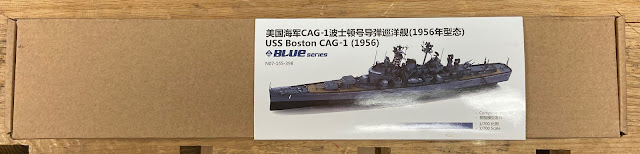
Below are kits from NIKO models and the newest release from Blue Ridge Models of the USS Boston.


The following is the list of kits from Bill's presentation covering this subject. Thanks Bill for putting together this great presentation!
§Revell
§USS Canberra CAG-2 1/480
§USS Boston CAG-1 1/480
§USS Long Beach CG-9 1/508
§USS Chicago CG-11 1/500
§Niko 1/700
§USS Canberra CAG-2 1967
§USS Springfield CLG-7 1970
§USS Galveston CLG-3 1968
§Jag 1/700
§USS Long Beach CG-9 1960s
§USS Albany CG-10
§Cyberhobby 1/700
§USS Long Beach CG-9 1980s
§USS Long Beach CG-9 1960s
§USS Albany CG-10
§Iron Shipwight 1/350
§USS Long Beach 1/350
§USS Albany 1/350
§Orange Hobby 1/350
§USS Boston CAG-1
§Jim Shirley 1/700
§USS Chicago CG-11
§Renewal 1/500
§USS Galveston 1/500
§USS Springfield CLG-7 1/500

Finishing off, Hugh Letterly brought in the model of the USS Shenandoah 1925 that he received from David Angelo, owner of Loose Cannon East. This is the perfect companion piece to David's USS Patoka. The Shenandoah is a resin kit available delivered for $55. You can pick up the Patoka for $75 delivered. David's web site is back up at this Link. You can order directly from him. Thanks for bringing this one in Hugh! Very nice subject!


Thanks everyone and we'll see you next time!
Tuesday, December 31, 2019
Happy New Year Ship Club!
Our meeting will be this Saturday...
Meeting Location: Rockler Woodworking (in the basement)
2553 S. Colorado Blvd., Suite 108
Denver, Colorado 80222
Date: January 4, 2020
Time: 10:00
Here's the itinerary for our meeting...
Bill Smallshaw will deliver a presentation on guided missile cruisers. I've seen the slides and it looks great. Bill is also researching model kits that he'll be discussing during his talk.

John DuGene recently experienced a challenge of cleaning up a corrugated joint. He found a solution and is going to share it with us. While this was learned on a winged subject, it has applications for ship building and other subjects.

I will be giving a talk about my experience with Mission Model Paints. The good, the bad, and the ugly. We'll also follow up on our discussion about our visit with John Miller from Model Paint Solutions. What a scientist can teach us about paint management.

As always...
Bring any questions you have
Brining any works in progress you would like to share
Bring any of the goodies you got during the holidays!
Friday, December 13, 2019
Greetings all,
Our December meeting was excellent. We had another healthy dose of history and wonderful build by Rodrigo and Sam.
The meeting started off with an excellent presentation on Fort Drum by Sam. I think we all learned a great deal about this coastal fort in the Philippines. For example I had always thought the gun turrets were naval turrets plopped down on the concrete bunker. As it turned out they were quite different. it's remarkable how much punishment that installation took

I found one book on this subject available in paperback on Amazon.

There are several kits on the subject. John shared his model with us at during the October meeting. This is the OKB Grigorov in 1/700 scale. Here's a link to a review of this kit.
Here is John's wonderful build. Note that John modified his kit to include the buildings which are mostly missing from this kit. I found it at Starling Models in the UK for 60 Euros, and on eBay for $68.

A more complete kit in 1/350 scale is available from Blue Ridge Models or Free Time Hobbies.
Here's a link to a review of this kit on Steel Navy web site. Free Time Hobbies currently has this kit on sale for $200. That's a big chunk of resin!

Next Dr. Rodrigo Banegas treated us to his build of the 1/700 type 42 Destroyer. Rodrigo gave us a short review of the Falklands War and the role of this destroyer. This was Rodrigo's first ship build which spanned over many years as he was working through his medical certifications and learning curve with this ship. Rodrigo did some amazing soldering and scratch building with this model.
Unfortunately for us Rodrigo is moving to Florida to pursue his career as a surgeon. Good luck Rodrigo and stay in touch!

Proud father!


Next Roger shared with us a dilemma he faced while painting a 1/700 destroyer. He had used some Duplicor primer. The finish paint was AK Interactive naval colors. Unfortunately he experienced some lifting of the paint when the masking tape was removed. Roger did some experimenting with different primers. While he still had a tiny spot of paint lift with the Duplicor, he had good results with the Vallejo and Stynylrez primers.

I performed a similar test using Stynylrez primer and Krylon Camoflauge paint. My test was based on experience trying to prime a resin kit with Stynylrez which had never failed me to this point. There was something about this resin that would not accept the water based Stynylrez primer. It was recommended to me by Last Cavalary Hobbies to use the Krylon Camoflauge paint as a primer. It's designed to cover difficult plastic surfaces such as water coolers, boats, etc. Sure enough it performed beautifully on the resin kit and in my test with acrylic paints.
If you're building a resin kit or having trouble with a difficult plastic material, considering using this paint as your primer.
Jerry gave us a review from the last meeting on the time he spent with John Miller from Model Paint Solutions. John is a retired college professor and scientist. He's incorporated some of the tools he used into his model making. He taught us some interesting techniques that I know I've already incorporated into my painting regiment. John is a representative of Harder and Steenbeck airbrushes as well. He learned about the joys of airbrushing at altitude which he is currently writing a paper on after his experience here.
Unfortunately some of the items we ordered from John didn't arrive in time, and we didn't give Jerry the proper time this deserved. We're going to come back to this at our next meeting. In the mean time here's a link to John's web site. You may find some interesting information here as well.
Lastly here are the Fairey Gannet aircraft that Sam built. Sam opened up the cockpits on these little guys. The paint schemes on these models are remarkable. Also note the folding wings on the center aircraft. Fantastic work Sam! Here's a LINK to information about these aircraft. Orange Hobby has this kit available. There are four aircraft per kit, and there is a photo etch detail set from Artist Hobby. You can get them from Free Time Hobbies.

Here's a close up view of the actual aircraft

Wednesday, December 4, 2019
Greetings all,
Ship Club Time!
Meeting Location
Rockler Woodworking (in the basement)
2553 S. Colorado Blvd., Suite 108
Denver, Colorado 80222
Date: December 6, 2019
Time: 10:00 AM
We have a BUSY schedule for our meeting as we head into the holiday seasons.
Jerry will be giving us a recap on the airbrushing clinic at Colpar. John Miller who owns Model Paint Solutions gave an excellent demonstration and gave us some ideas about how we can be more productive with our airbrushing.

Sam will be delivering a presentation on Fort Drum. You'll remember that John brought in his 1/700 resin model. Now Sam will give us some history on this iconic structure that still stands today in the Philippines. Kits are available in 1/700 and 1/350.

Rodrigo will be delivering a presentation on his Argentine ship models. This will be Rodrigo's last meeting with us as he's moving to Florida soon. Rodrigo has an interesting personal story about these ships during the Falklands War, and he's excellent with his fine soldering and details.

New addition to the schedule....
Roger is doing a test on primers and AK Interactive acrylic paints. He ran into some issues with Duplicolor primer and is testing several different options to see what works. I also did some tests and will support Roger with his presentation. I'm looking forward to Roger's results.

John DuGene has also been experimenting with good sanding and filling techniques for corrugated material. I gave John the option of covering this meeting or next, depending on what makes sense in the building process.
I will likely hold off on my presentation of Mission Models acrylic paints until January.

As always bring....
Your questions and challenges
Your in progress and completed models
I look forward to seeing you all Saturday!
Ship Club Time!
Meeting Location
Rockler Woodworking (in the basement)
2553 S. Colorado Blvd., Suite 108
Denver, Colorado 80222
Date: December 6, 2019
Time: 10:00 AM
We have a BUSY schedule for our meeting as we head into the holiday seasons.
Jerry will be giving us a recap on the airbrushing clinic at Colpar. John Miller who owns Model Paint Solutions gave an excellent demonstration and gave us some ideas about how we can be more productive with our airbrushing.

Sam will be delivering a presentation on Fort Drum. You'll remember that John brought in his 1/700 resin model. Now Sam will give us some history on this iconic structure that still stands today in the Philippines. Kits are available in 1/700 and 1/350.

Rodrigo will be delivering a presentation on his Argentine ship models. This will be Rodrigo's last meeting with us as he's moving to Florida soon. Rodrigo has an interesting personal story about these ships during the Falklands War, and he's excellent with his fine soldering and details.
New addition to the schedule....
Roger is doing a test on primers and AK Interactive acrylic paints. He ran into some issues with Duplicolor primer and is testing several different options to see what works. I also did some tests and will support Roger with his presentation. I'm looking forward to Roger's results.

I will likely hold off on my presentation of Mission Models acrylic paints until January.

As always bring....
Your questions and challenges
Your in progress and completed models
I look forward to seeing you all Saturday!
Subscribe to:
Posts (Atom)